


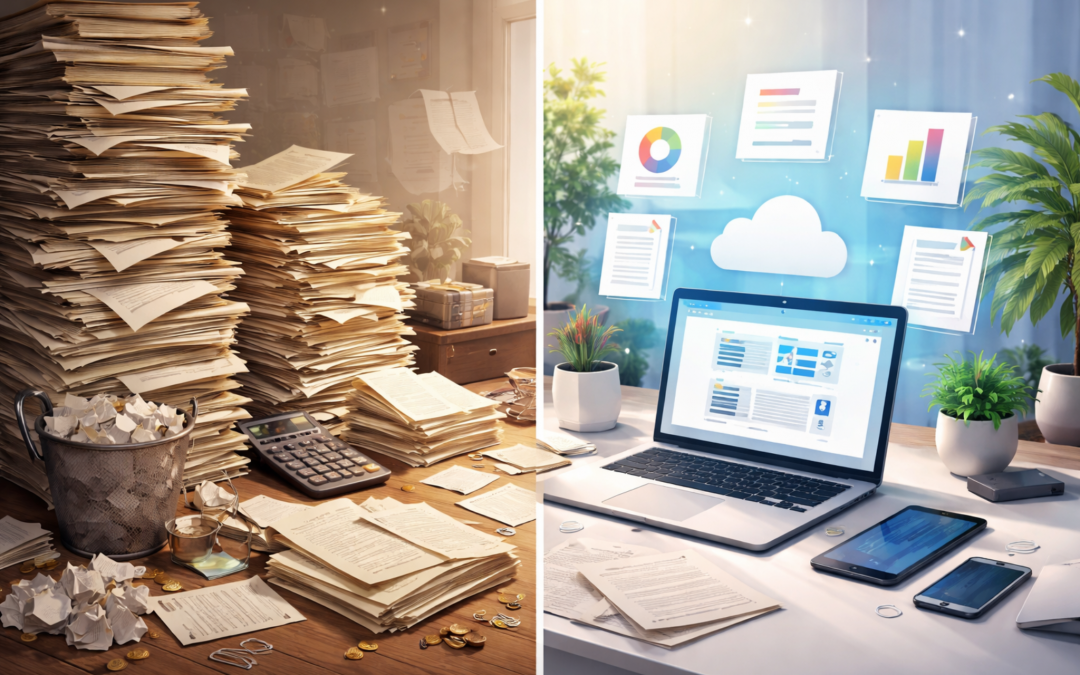
For many businesses, paper still feels dependable. Filing cabinets line the walls, archive boxes fill cupboards, and off-site storage contracts quietly renew each year. On the surface, paper records seem manageable. But when you look closer, paper brings costs that often go unnoticed.
Digitising documents is not just about freeing up office space. It’s about reducing risks, saving time, improving security and making day-to-day work easier.
For organisations that want to operate efficiently in a digital world, paper can quickly become a liability.
The Real Cost of Physical Storage
Paper doesn’t just take up space: it takes up valuable space.
Office square footage is expensive, whether it’s rented or owned. Filing cabinets, storage rooms and archive areas all compete with productive workspace. Off-site storage might feel cheaper, but ongoing fees add up over time, especially when you factor in retrieval charges and staff’s time.
There’s also the issue of growth. As your business generates more paperwork, storage needs increase. Many organisations find themselves paying more each year just to keep hold of information they rarely access.
Digitising documents removes this problem entirely. Files stored securely in a digital document management system take up no physical space and scale easily as your business grows.
Time Is Money and Paper Wastes Both
Finding a paper document sounds simple until you time it.
Staff may spend several minutes searching through filing cabinets, archive boxes or storage rooms. Multiply that by dozens of searches per week, across multiple employees, and the lost time becomes significant.
Paper also slows down your ability to collaborate. Only one person can use a document at a time. Files get misfiled, copied or left on desks. In remote or hybrid working environments, paper becomes even more impractical.
With digitised records, documents are searchable, instantly accessible, and available to authorised users wherever they are. Our document scanning and electronic document management solutions are designed to make information easy to find, not hidden behind folders and labels.
The Risk You Don’t See Until It’s Too Late
Paper records are vulnerable in ways many businesses underestimate. They’re not just at risk of fires, floods or accidental damage, but theft and unauthorised access.
Compliance adds another layer of pressure. Data protection regulations require organisations to control who can access personal and confidential information. With paper, tracking access and ensuring it’s securely disposed of is difficult.
Digitising documents allows for controlled access, audit trails, encryption, and secure backups. MISL supports this with ISO 27001-certified information security management, giving clients confidence that their data is protected to the highest standards.
The Hidden Environmental Cost of Paper
Sustainability is no longer optional. Customers, employees, and partners increasingly expect businesses to act responsibly.
Paper has an environmental footprint that goes far beyond the page itself. Printing, copying, transporting, and storing documents all consume resources. Old records eventually need shredding and disposal, adding further cost and waste.
MISL works with businesses to strike the right balance, helping you reduce the amount of paper you use without disrupting essential processes.
Security Isn’t Just Digital Anymore
Many organisations invest heavily in cybersecurity while overlooking physical document security.
Paper files left on desks, in meeting rooms or in unlocked cabinets are easy targets for data breaches. Secure destruction is often inconsistent, increasing the risk of sensitive information being exposed.
MISL’s secure data destruction services ensure confidential paper records are disposed of safely and in compliance with regulations. When combined with document scanning, businesses can reduce physical risk while maintaining secure digital access.
Certifications such as Cyber Essentials Plus and ICO Data Protection Registration demonstrate MISL’s commitment to safeguarding information at every stage of its lifecycle.
Supporting Modern Ways of Working
The way people work has changed. Flexible hours, remote access, and mobile teams are now standard across many industries.
Paper doesn’t support this shift. Employees working from home can’t easily access physical files. Important decisions get delayed because information isn’t available when it’s needed.
Digitised documents support modern working practices, with secure access from anywhere. Combined with cloud storage, unified communications, and digital mailroom services, businesses can operate smoothly without being tied to a physical office.
Our integrated approach means document management works alongside broader business systems, rather than sitting in isolation.
Compliance Made Simpler
Regulatory compliance is a major concern for many organisations, particularly those handling personal or sensitive data.
Paper records make it difficult to demonstrate compliance. Audit trails are limited, and retrieving records for audits can be time-consuming. Digital document management systems make compliance more manageable. Records can be categorised, retention rules applied automatically, and access logged clearly.
MISL’s ISO 9001 quality management certification reflects a commitment to consistent, reliable processes that support compliance and operational confidence.
More Than Document Scanning
Digitisation is most effective when it’s part of a wider strategy.
MISL began as a pioneer in document management in 1980, building a reputation for secure scanning, storage and destroying old documents. Over time, that expertise has expanded into a full range of integrated business services.
From cloud-hosted storage and on-site or off-site backups to managed print services, MISL helps organisations improve efficiency across their operations.
For more information on our document scanning services, simply get in touch today.
Recent Comments